History and geography · Learn key parts of Dutch history and their present-day traces.
Older History and Life with Water
Sources checked on
Beta version: the content and translations are still being reviewed. Check official sources before making decisions about your exam.
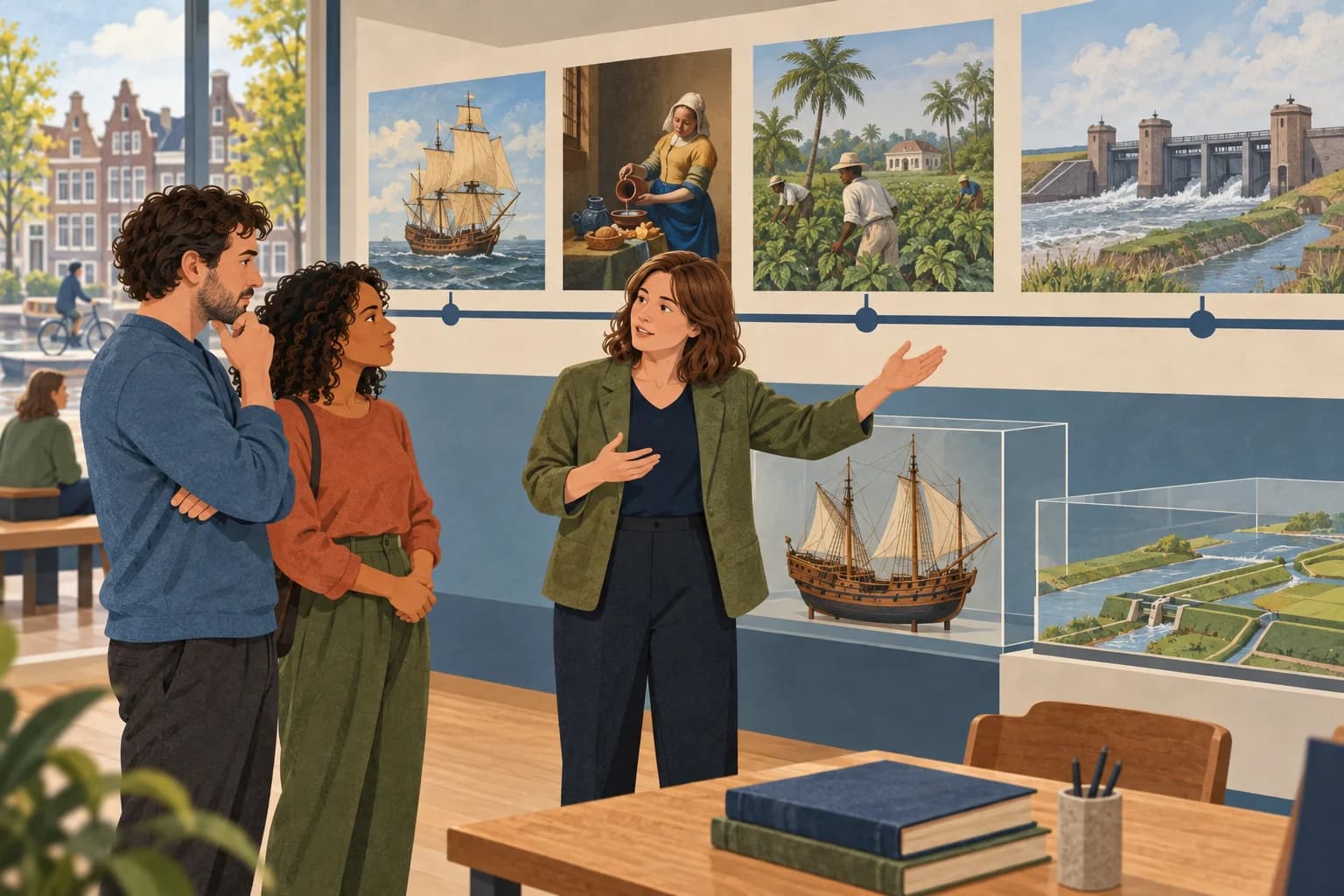
When you walk through an old Dutch city, you see buildings, canals, and paintings from the seventeenth century. During this period, shipping and trade expanded rapidly. Merchants sold goods in Europe and overseas. Painters and builders received commissions from people who had become wealthy. For this reason, this century is often called the Golden Age (Gouden Eeuw). However, that name only tells one side of the story: the wealth was not shared by everyone.
Dutch trading companies and government officials took possession of territories outside Europe. In the colonies, people were forced to work. People were enslaved, traded, and, among other things, put to work on plantations. So, when you look at a painting or an old building, you can also ask where the money came from and whose story is missing. The colonial and slavery past is part of Dutch history.
Moreover, the Netherlands has lived with water for centuries. Much of the country lies low. Dikes hold back the water; a 'polder' is an area where people control the water level, for example, using pumping stations. In the past, windmills helped to pump out water. After major floods, the Delta Works (Deltawerken) were built. These barriers protect parts of the country from the sea. Even now, organisations check the safety of dikes and water barriers.
You encounter the past in national symbols. The flag has red, white, and blue stripes, and the Wilhelmus is the national anthem. You do not need to know every verse to understand that these symbols refer to a shared history. At the same time, be aware that people have experienced this history in different ways. Visiting a museum or taking a walk along a dike can make these concepts more tangible.
Check your understanding
Name one visible sign of how the Dutch interact with water. Show answer
A dike, polder, windmill, or the Delta Works.
These structures show how people manage water.
Which violent history is also connected to the trade of the seventeenth century? Show answer
Dutch colonisation and slavery.
Prosperity and culture should not hide this history.
You see a dike, polder, and windmill. With which ongoing issue in the Netherlands are these connected? Show answer
With living and working with water and protection from flooding.
These buildings demonstrate the history of water management.
A museum displays paintings and trade buildings from the seventeenth century. Which two sides of that history do you investigate? Show answer
The growth from shipping and trade, and the colonial history involving slavery and exploitation.
The past has different sides that need to be explained together.
What is the Dutch national anthem and what colours does the flag have? Show answer
The Wilhelmus; the flag is red, white, and blue.
These are recognisable national symbols.
Sources: zoek.officielebekendmakingen.nl · stcrt 2024 15802.html · rijksmuseum.nl · West Indische Compagnie WIC 6ce37825be4846f6bb3e683aea272840 · rijkswaterstaat.nl · deltawerken
Original Dutch text
Oudere geschiedenis en leven met water
Wie door een oude Nederlandse stad loopt, ziet gebouwen, grachten en schilderijen uit de zeventiende eeuw. In die tijd groeiden scheepvaart en handel sterk. Kooplieden verkochten goederen in Europa en overzee. Schilders en bouwers kregen opdrachten van mensen die rijk waren geworden. Daarom wordt deze eeuw vaak de Gouden Eeuw genoemd. Die naam vertelt maar één kant van het verhaal: de rijkdom was niet voor iedereen.
Nederlandse handelsbedrijven en bestuurders namen gebieden buiten Europa in bezit. In de koloniën moesten mensen onder dwang werken. Mensen werden tot slaaf gemaakt, verhandeld en onder meer op plantages te werk gesteld. Wanneer je een schilderij of oud gebouw bekijkt, kun je dus ook vragen waar het geld vandaan kwam en wiens verhaal ontbreekt. Het koloniale en slavernijverleden is onderdeel van de Nederlandse geschiedenis.
Nederland leeft bovendien al eeuwen met water. Een groot deel van het land ligt laag. Dijken houden water tegen; een polder is een gebied waar mensen het waterpeil regelen, bijvoorbeeld met gemalen. Vroeger hielpen molens bij het wegpompen van water. Na grote overstromingen werden de Deltawerken gebouwd. Deze waterkeringen beschermen delen van het land tegen de zee. Ook nu controleren organisaties de veiligheid van dijken en waterkeringen.
Je komt het verleden tegen in nationale symbolen. De vlag heeft rode, witte en blauwe banen en het Wilhelmus is het volkslied. Je hoeft niet ieder vers te kennen om te begrijpen dat deze symbolen naar een gedeelde geschiedenis verwijzen. Leer tegelijk dat mensen die geschiedenis verschillend hebben meegemaakt. Een bezoek aan een museum of een wandeling langs een dijk maakt deze begrippen concreet.
Controleer wat je weet
Noem één zichtbaar spoor van de Nederlandse omgang met water. Toon antwoord
Een dijk, polder, molen of de Deltawerken.
Deze werken laten zien hoe mensen water beheren.
Welke gewelddadige geschiedenis hoort ook bij de handel in de zeventiende eeuw? Toon antwoord
Nederlandse kolonisatie en de slavernij.
Welvaart en cultuur mogen deze geschiedenis niet verhullen.
Je ziet een dijk, polder en molen. Met welk langdurig probleem in Nederland hangen die samen? Toon antwoord
Met leven en werken bij water en bescherming tegen overstroming.
Deze bouwwerken laten de watergeschiedenis zien.
Een museum toont schilderijen en handelsgebouwen uit de zeventiende eeuw. Welke twee kanten van die geschiedenis onderzoek je? Toon antwoord
De groei door scheepvaart en handel, én de koloniale geschiedenis met slavernij en uitbuiting.
Het verleden heeft verschillende kanten die samen uitgelegd moeten worden.
Welk lied is het Nederlandse volkslied en welke kleuren heeft de vlag? Toon antwoord
Het Wilhelmus; de vlag is rood, wit en blauw.
Dit zijn herkenbare nationale symbolen.