History and geography · Use knowledge of Dutch places and public transport.
Travelling by Public Transport
Sources checked on
Beta version: the content and translations are still being reviewed. Check official sources before making decisions about your exam.
Public transport, often called OV in Dutch, lets you travel by train, bus, tram, or metro. Before you leave, use a journey planner. Enter where you are starting from, your destination, and the time you want to arrive. Do not just look at the first departure time, but also check the stop, the platform, any changes (transfers), and the total travel time. If you have an important appointment, schedule some extra time in case of delays.
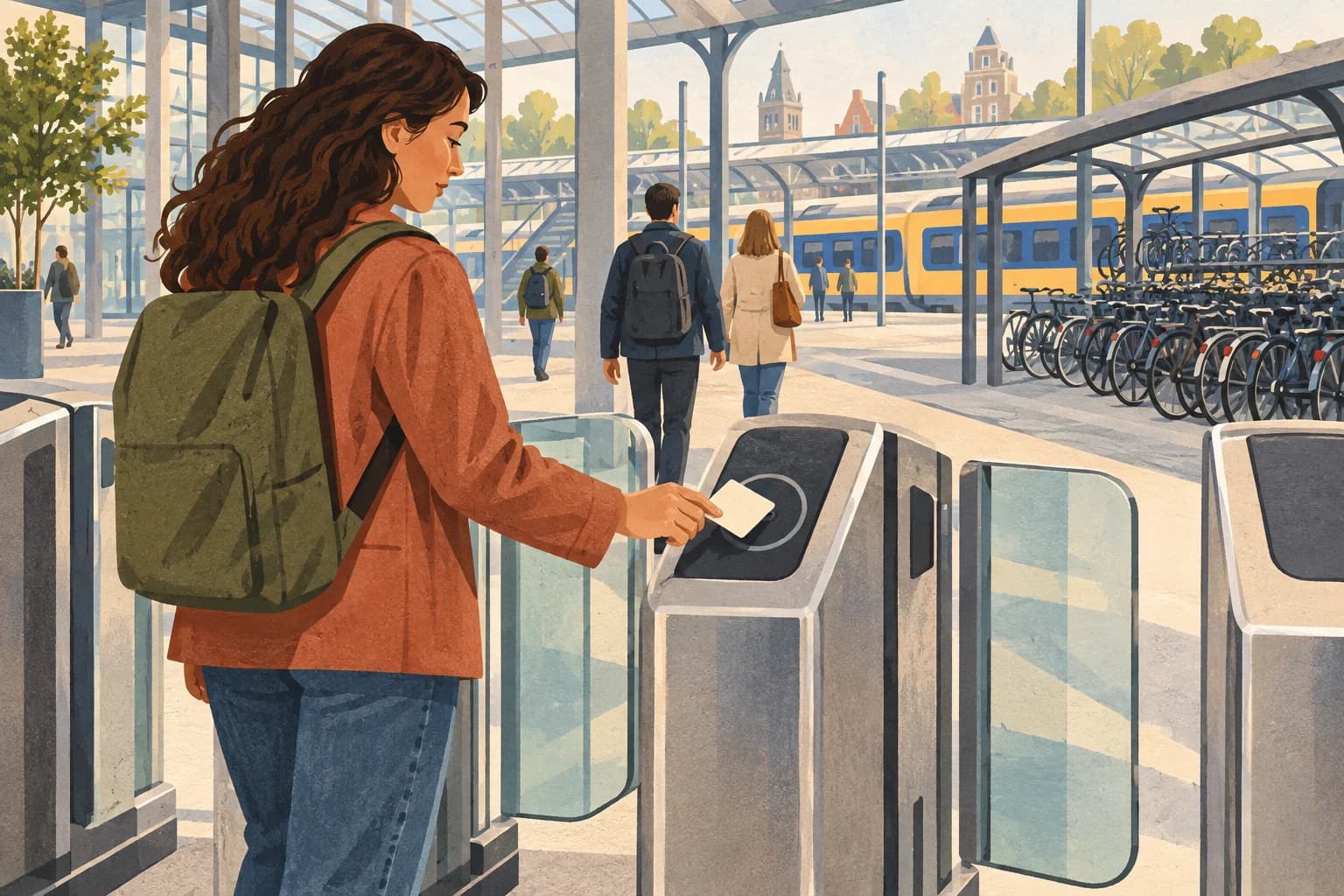
Depending on the transport company, you may use an OV-chipkaart (public transport chip card), a debit card, your mobile phone, or a separate ticket to pay for your journey. Check in advance which payment method you can use for your route and see if you are eligible for any discounts. Checking in and checking out are two separate actions. Use the same payment method for both when making one journey. If you are changing between different transport companies, you may need to check out and check in again. Follow the signs and the instructions from the transport companies.
Imagine you are taking the bus to the station and then the train. First, check the direction of the bus and the name of the stop. At the station, look at the departure board: which platform and what departure time match your train? Trains to the same city may stop at different stations along the way. Therefore, also look at the route, and if you are unsure, ask staff for help.
Sometimes a journey is cancelled or the platform changes. Check the journey planner shortly before you leave and again when transferring. Find a new connection if needed and inform someone if you are going to be late. Keep a single-use ticket until the end of your journey and keep your card or phone accessible for ticket inspections. If you notice a payment error, contact the transport company or the payment organisation.
Try this
- Plan your route based on arrival time and note each transfer.
- Check for every transport company which ticket or payment is valid, and where to check in and out.
- Shortly before leaving, check for disruptions and plan an alternative if needed.
Check your understanding
What do you check before travelling by train and bus? Show answer
Route, departure time, transfers, and the method of payment or checking in.
Also check for any changes shortly before departure.
You first travel by bus and then by train. Which four things do you check before departure? Show answer
Departure and arrival times, transfers, payment method, and where to check in and out for both transport companies.
Changing between transport companies may require separate actions.
Your train is cancelled and you have an appointment. What do you do? Show answer
Look for a current alternative route, ask staff for help if needed, and inform in time that you will arrive later.
Being able to travel independently also means responding to changes.
Sources: zoek.officielebekendmakingen.nl · stcrt 2024 15802.html · ovpay.nl
Original Dutch text
Met het openbaar vervoer reizen
Met het openbaar vervoer, vaak OV genoemd, kun je reizen met trein, bus, tram of metro. Voor vertrek gebruik je een reisplanner. Vul in waar je vertrekt, waar je heen wilt en wanneer je wilt aankomen. Lees niet alleen de eerste vertrektijd, maar ook de halte, het spoor, de overstappen en de totale reistijd. Plan bij een belangrijke afspraak wat extra tijd voor vertraging.
Voor een reis kun je, afhankelijk van de vervoerder, een OV-chipkaart, betaalpas, telefoon of apart ticket gebruiken. Zoek vooraf uit welke betaalwijze op jouw route werkt en of een korting voor jou geldt. In- en uitchecken zijn aparte handelingen. Gebruik bij een rit hetzelfde betaalmiddel voor beide handelingen. Stap je over tussen vervoerders, dan kan opnieuw uitchecken en inchecken nodig zijn. Volg de borden en de aanwijzingen van de vervoerders.
Stel dat je met de bus naar het station gaat en daarna de trein neemt. Controleer eerst de richting van de bus en de naam van de halte. Op het station kijk je naar het vertrekbord: welk spoor en welke vertrektijd horen bij jouw trein? Een trein naar dezelfde stad kan onderweg op andere stations stoppen. Kijk daarom ook naar de route en vraag zo nodig personeel om hulp.
Soms valt een rit uit of verandert het spoor. Controleer de reisplanner kort voor vertrek en opnieuw bij een overstap. Zoek een nieuwe verbinding als dat nodig is en laat iemand weten dat je later komt. Bewaar een los vervoersbewijs tot het einde van de reis en houd je kaart of telefoon bij de hand voor controle. Als je een betaalfout ziet, neem dan contact op met de vervoerder of betaalorganisatie.
Probeer dit
- Plan de route op aankomsttijd en noteer elke overstap.
- Controleer per vervoerder het bewijs en de plaats van in- en uitchecken.
- Bekijk kort voor vertrek storingen en plan zo nodig een alternatief.
Controleer wat je weet
Wat controleer je voordat je met trein en bus reist? Toon antwoord
Route, vertrektijd, overstap en manier van betalen of inchecken.
Controleer kort voor vertrek ook wijzigingen.
Je reist eerst met bus en daarna met trein. Welke vier dingen controleer je voor vertrek? Toon antwoord
Vertrek- en aankomsttijd, overstap, betaalwijze en waar je bij beide vervoerders in- en uitcheckt.
Bij een overstap tussen vervoerders kunnen aparte handelingen nodig zijn.
Je trein valt uit en je hebt een afspraak. Wat doe je? Toon antwoord
Zoek een actuele alternatieve route, vraag zo nodig personeel om hulp en meld op tijd dat je later komt.
Zelfstandig reizen betekent ook op een wijziging kunnen reageren.