Health and healthcare · Access primary care and other care that needs no referral.
Medicines and the Pharmacy
Sources checked on
Beta version: the content and translations are still being reviewed. Check official sources before making decisions about your exam.
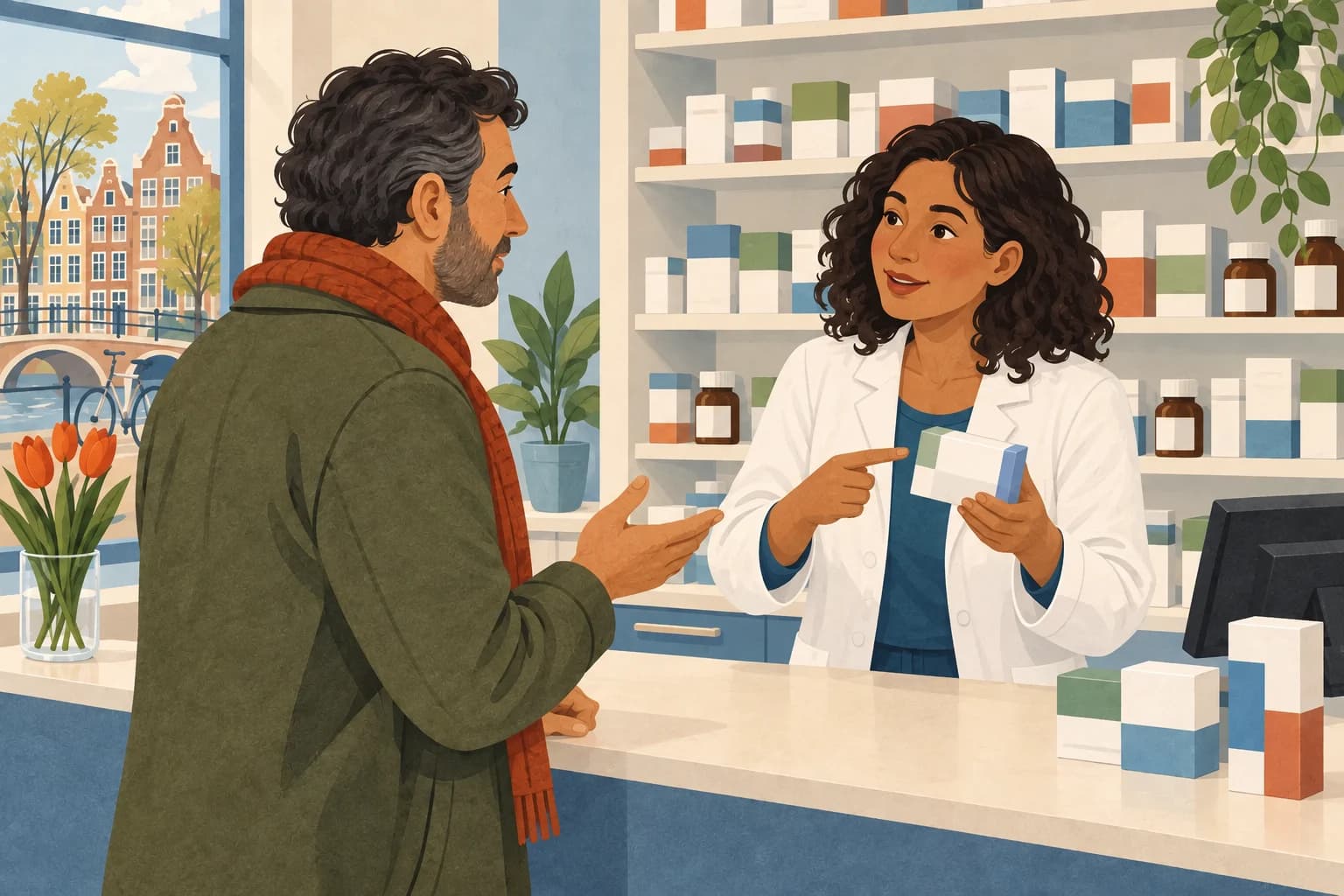
A doctor can give a prescription for a medicine. With this, you collect the medicine at a pharmacy. The pharmacist checks whether the medicine is suitable with other products you use. For this reason, always mention any medicines you have bought without a prescription. Ask how often and how long you must take the medicine.
On the packaging and in the leaflet you find information about how to use the medicine and possible side effects. Sometimes you must take a medicine with food; other times, without. If you forget a dose or experience a side effect, ask the pharmacy or your doctor what you should do. Do not change a prescribed treatment yourself just because you have seen an example in a lesson. Write down the name of the medicine and the reason you use it. Take this information with you if you visit a new doctor or need a different pharmacy.
Some products are available without a prescription, for example from a chemist. This is called a self-care medicine. Without a prescription does not mean without risk: such products can also cause side effects or interact badly with other medicines. If you are not sure, the pharmacist or doctor can look at this with you.
If you do not understand the instructions, ask for a simple explanation. Also say if you have difficulty swallowing or if a schedule does not fit into your daily routine. The pharmacist can sometimes discuss a safe solution with you. If complaints persist or get worse, contact a healthcare provider again.
Check your understanding
What do you usually need to get a prescribed medicine at the pharmacy? Show answer
A prescription.
The pharmacist can explain how to use the medicine.
You want to buy a product without a prescription from the chemist but are already taking medicines. What do you do? Show answer
Ask a pharmacist or doctor whether it is safe to use together.
Products without a prescription can also have risks or interactions.
You forget a dose of a prescribed medicine. What do you do? Show answer
Ask the pharmacy or doctor what you should do.
Do not change your treatment yourself based on a general example.
Why do you tell the pharmacist about a medicine you bought without a prescription? Show answer
Because such a product can also cause side effects or interact badly with other medicines.
The pharmacist checks whether medicines can be used safely together.
Sources: zoek.officielebekendmakingen.nl · stcrt 2024 15802.html · rijksoverheid.nl · voor welk medicijn recept nodig
Original Dutch text
Medicijnen en de apotheek
Een arts kan een recept geven voor een medicijn. Daarmee haal je het middel bij een apotheek op. De apotheker controleert of het medicijn bij andere middelen past die je gebruikt. Vertel dus ook over medicijnen die je zonder recept hebt gekocht. Vraag hoe vaak en hoe lang je het middel moet nemen.
Op de verpakking en in de bijsluiter staat informatie over gebruik en mogelijke bijwerkingen. Soms moet je een medicijn met eten nemen, soms juist niet. Als je een dosis vergeet of een bijwerking krijgt, vraag dan aan de apotheek of arts wat je moet doen. Verander een voorgeschreven behandeling niet alleen op basis van een voorbeeld uit een les. Noteer de naam van het medicijn en de reden waarom je het gebruikt. Neem die informatie mee als je een nieuwe arts bezoekt of een andere apotheek nodig hebt.
Sommige middelen zijn zonder recept verkrijgbaar, bijvoorbeeld bij een drogist. Dat heet een zelfzorgmiddel. Zonder recept betekent niet zonder risico: ook zulke middelen kunnen bijwerkingen hebben of slecht samengaan met andere medicijnen. Bij twijfel kan de apotheker of arts met je meekijken.
Begrijp je de instructie niet, vraag dan om eenvoudige uitleg. Zeg ook als slikken moeilijk is of als een schema niet past bij je dagelijks leven. De apotheker kan soms een veilige oplossing bespreken. Blijven klachten bestaan of worden ze erger, neem dan opnieuw contact op met een zorgverlener.
Controleer wat je weet
Wat heb je meestal nodig om een voorgeschreven medicijn bij de apotheek te krijgen? Toon antwoord
Een recept.
De apotheker kan uitleggen hoe je het medicijn gebruikt.
Je wilt een middel zonder recept bij de drogist kopen maar gebruikt al medicijnen. Wat doe je? Toon antwoord
Vraag een apotheker of arts of het veilig samen kan.
Ook middelen zonder recept kunnen risico’s of wisselwerkingen hebben.
Je vergeet een dosis van een voorgeschreven medicijn. Wat doe je? Toon antwoord
Vraag de apotheek of arts wat je moet doen.
Verander de behandeling niet zelf op basis van een algemeen voorbeeld.
Waarom vertel je de apotheker ook over een middel dat je zonder recept koopt? Toon antwoord
Omdat ook zo'n middel bijwerkingen kan hebben of slecht met andere medicijnen kan samengaan.
De apotheker controleert of geneesmiddelen veilig samen kunnen worden gebruikt.