History and geography
Learn key parts of Dutch history and their present-day traces.
All knowledge points: Older history and living with water · War, migration and change
Sources checked on
Beta version: the content and translations are still being reviewed. Check official sources before making decisions about your exam.
Older history and living with water
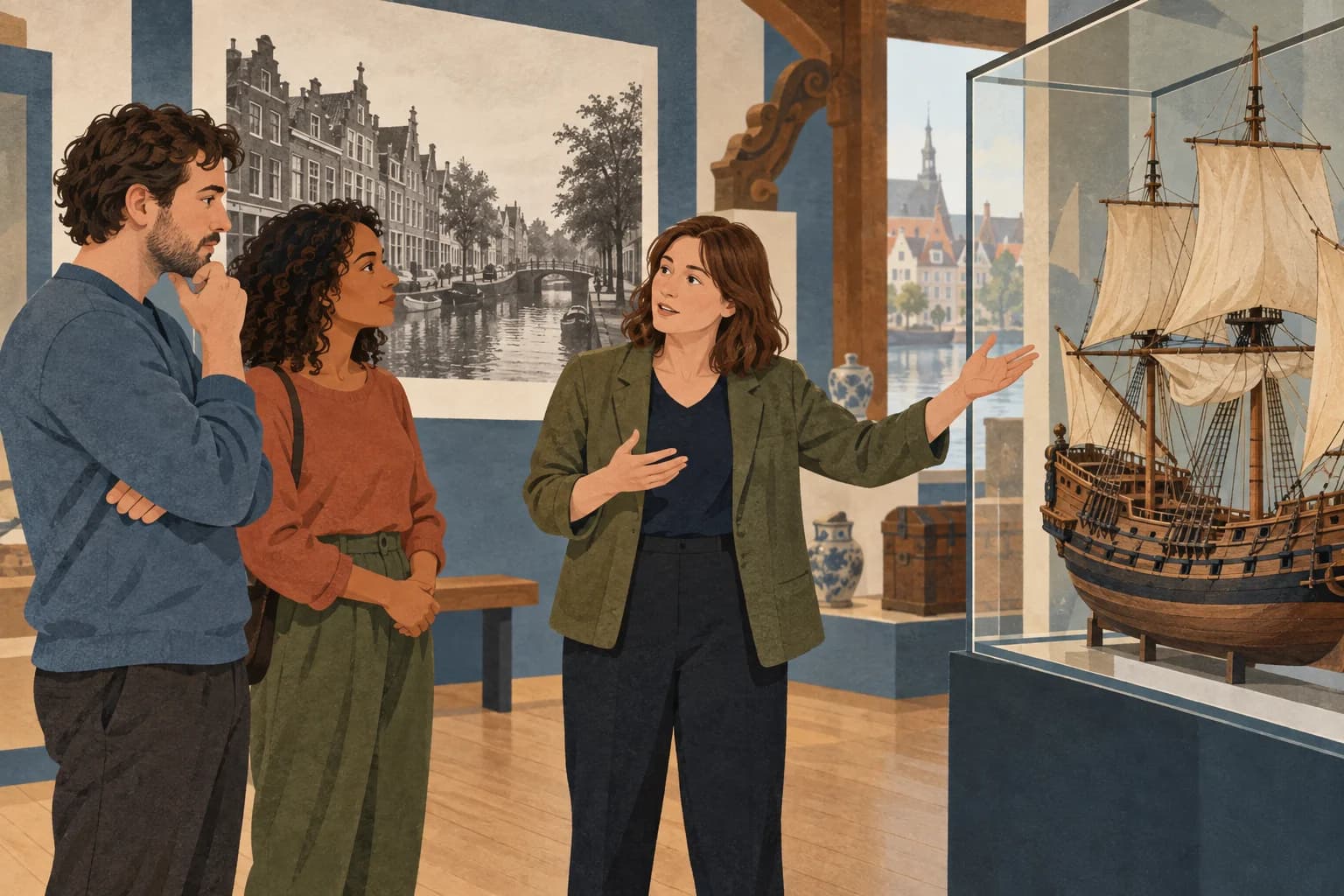
In the seventeenth century, shipping, trade, painting, and architecture grew in the Netherlands. You can still see traces of this in old city buildings and paintings. This prosperity also had a violent side: the Netherlands founded colonies, enslaved people, traded them, and made them work on plantations.
Water has shaped the country strongly. A polder is land where people manage the water level themselves. Windmills, dykes, and the Delta Works show how people protect themselves against water and make land usable.
There are also national symbols linked to this subject. The Dutch flag has horizontal stripes in red, white and blue. The Wilhelmus is the national anthem. A symbol does not tell the whole past; learn the history behind it as well.
Check your understanding
Name one visible trace of how the Dutch have dealt with water. Show answer
A dyke, polder, windmill or the Delta Works.
These works show how people manage water.
What violent history is also related to trade in the seventeenth century? Show answer
Dutch colonisation and slavery.
Prosperity and culture should not hide this part of history.
You see a dyke, polder and windmill. With what long-standing problem in the Netherlands are these connected? Show answer
With living and working near water and protection against flooding.
These constructions show the history of water in the Netherlands.
A museum shows paintings and trading buildings from the seventeenth century. Which two sides of that history do you explore? Show answer
The growth through shipping and trade, and the colonial history with slavery and exploitation.
The past has different sides that need to be explained together.
Which song is the Dutch national anthem, and what colours does the flag have? Show answer
The Wilhelmus; the flag is red, white and blue.
These are recognisable national symbols.
Sources: zoek.officielebekendmakingen.nl · stcrt 2024 15802.html · rijksmuseum.nl · West Indische Compagnie WIC 6ce37825be4846f6bb3e683aea272840 · rijkswaterstaat.nl · deltawerken
Original Dutch text
Oudere geschiedenis en leven met water
In de zeventiende eeuw groeiden scheepvaart, handel, schilderkunst en bouwkunst in Nederland. Je ziet sporen daarvan in oude stadsgebouwen en schilderijen. Deze welvaart had ook een gewelddadige kant: Nederland stichtte koloniën en maakte mensen tot slaaf, verhandelde hen en liet hen op plantages werken.
Water heeft het land sterk gevormd. Een polder is land waarvan mensen het waterpeil beheren. Molens, dijken en de Deltawerken laten zien hoe mensen zich tegen water beschermen en land bruikbaar maken.
Ook nationale symbolen horen bij dit onderwerp. De Nederlandse vlag heeft horizontale banen in rood, wit en blauw. Het Wilhelmus is het volkslied. Een symbool vertelt niet het hele verleden; leer ook de geschiedenis erachter.
Controleer wat je weet
Noem één zichtbaar spoor van de Nederlandse omgang met water. Toon antwoord
Een dijk, polder, molen of de Deltawerken.
Deze werken laten zien hoe mensen water beheren.
Welke gewelddadige geschiedenis hoort ook bij de handel in de zeventiende eeuw? Toon antwoord
Nederlandse kolonisatie en de slavernij.
Welvaart en cultuur mogen deze geschiedenis niet verhullen.
Je ziet een dijk, polder en molen. Met welk langdurig probleem in Nederland hangen die samen? Toon antwoord
Met leven en werken bij water en bescherming tegen overstroming.
Deze bouwwerken laten de watergeschiedenis zien.
Een museum toont schilderijen en handelsgebouwen uit de zeventiende eeuw. Welke twee kanten van die geschiedenis onderzoek je? Toon antwoord
De groei door scheepvaart en handel, én de koloniale geschiedenis met slavernij en uitbuiting.
Het verleden heeft verschillende kanten die samen uitgelegd moeten worden.
Welk lied is het Nederlandse volkslied en welke kleuren heeft de vlag? Toon antwoord
Het Wilhelmus; de vlag is rood, wit en blauw.
Dit zijn herkenbare nationale symbolen.
War, migration and change

Germany occupied the Netherlands during the Second World War. The Holocaust was the organised persecution and murder of Jews by Nazi Germany and its helpers; many Dutch Jews were also killed. Anti-Semitic discrimination and incitement to hatred are forbidden. The Netherlands was liberated in 1945. On 4 May, war victims are commemorated, and on 5 May, people celebrate freedom.
After the war, people from former colonies, labour migrants, and refugees came to the Netherlands. Their stories are part of Dutch history. The Netherlands also started closer cooperation with other countries, for example in the EU, NATO and UN.
Since the 1960s, individual freedom, emancipation, tolerance and self-determination have received more attention. Tolerance means giving space to people who live or think differently, even if you do not agree. You do not have to adopt another person's views, but you treat each other with respect according to the law.
Laws now regulate, under certain conditions, things such as abortion, marriage for same-sex partners, and euthanasia. The rules and conditions are different for each subject. If you are personally involved, look up the latest official information.
Check your understanding
What do people commemorate on 4 May? Show answer
Victims of the Second World War and later war situations.
On 5 May, people celebrate liberation.
Name two groups who migrated to the Netherlands after the war. Show answer
For example, people from former colonies, labour migrants or refugees.
Their history is part of modern Dutch society.
Someone thinks differently from you about a family or life choice. How can you show tolerance? Show answer
Listen and treat that person with respect, even if you do not agree.
Tolerance gives space to differences within the law.
Name two international organisations with which the Netherlands started cooperating after the war. Show answer
For example, the EU, NATO or UN.
International cooperation is part of post-war history.
Are abortion, marriage for same-sex partners and euthanasia regulated in the same way? Show answer
No. Each subject has its own legal rules and conditions.
Check the latest rules with an official source.
What happened to many Dutch Jews during the Second World War and why is anti-Semitism forbidden? Show answer
Many Jews were persecuted and murdered during the Holocaust; discrimination and incitement to hatred are forbidden.
This history makes clear why protection against anti-Semitism is important.
Sources: zoek.officielebekendmakingen.nl · stcrt 2024 15802.html · rijksoverheid.nl · tweede wereldoorlog · niod.nl · gedeporteerde Joden cijfers · rijksoverheid.nl · nationale herdenkingen
Original Dutch text
Oorlog, migratie en verandering
Duitsland bezette Nederland tijdens de Tweede Wereldoorlog. De Holocaust was de georganiseerde vervolging en moord op Joden door nazi-Duitsland en zijn helpers; ook veel Nederlandse Joden werden vermoord. Antisemitische discriminatie en het aanzetten tot haat zijn verboden. Nederland werd in 1945 bevrijd. Op 4 mei worden oorlogsslachtoffers herdacht en op 5 mei vieren mensen de vrijheid.
Na de oorlog kwamen mensen uit voormalige koloniën, arbeidsmigranten en vluchtelingen naar Nederland. Hun verhalen zijn deel van de Nederlandse geschiedenis. Nederland ging ook nauwer samenwerken met andere landen, onder meer in de EU, NAVO en VN.
Vanaf de jaren zestig kregen individuele vrijheid, emancipatie, tolerantie en zelfbeschikking meer aandacht. Tolerantie betekent dat je ruimte laat voor mensen die anders leven of denken, ook als je het niet met hen eens bent. Je hoeft het standpunt van een ander niet over te nemen, maar je behandelt elkaar volgens de wet met respect.
Wetten regelen nu onder voorwaarden onder meer abortus, het huwelijk voor partners van hetzelfde geslacht en euthanasie. De regels en voorwaarden zijn verschillend per onderwerp. Zoek actuele officiële informatie als je er persoonlijk mee te maken krijgt.
Controleer wat je weet
Wat herdenken mensen op 4 mei? Toon antwoord
Slachtoffers van de Tweede Wereldoorlog en latere oorlogssituaties.
Op 5 mei vieren mensen de bevrijding.
Noem twee groepen die na de oorlog naar Nederland migreerden. Toon antwoord
Bijvoorbeeld mensen uit voormalige koloniën, arbeidsmigranten of vluchtelingen.
Hun geschiedenis hoort bij de moderne Nederlandse samenleving.
Iemand denkt anders dan jij over een familie of levenskeuze. Hoe kun je tolerantie tonen? Toon antwoord
Luister en behandel die persoon met respect, ook als je het niet eens bent.
Tolerantie geeft ruimte aan verschillen binnen de wet.
Noem twee internationale organisaties waarmee Nederland na de oorlog ging samenwerken. Toon antwoord
Bijvoorbeeld EU, NAVO of VN.
Internationale samenwerking is een deel van de naoorlogse geschiedenis.
Zijn abortus, het huwelijk voor partners van hetzelfde geslacht en euthanasie hetzelfde geregeld? Toon antwoord
Nee. Voor elk onderwerp gelden eigen wettelijke regels en voorwaarden.
Controleer die actuele regels bij een officiële bron.
Wat gebeurde met veel Nederlandse Joden tijdens de Tweede Wereldoorlog en waarom is antisemitisme verboden? Toon antwoord
Veel Joden werden tijdens de Holocaust vervolgd en vermoord; discriminatie en aanzetten tot haat zijn verboden.
Deze geschiedenis maakt duidelijk waarom bescherming tegen antisemitisme belangrijk is.