Public services and institutions · Understand police services and respond to police directions.
When you need the police
Sources checked on
Beta version: the content and translations are still being reviewed. Check official sources before making decisions about your exam.
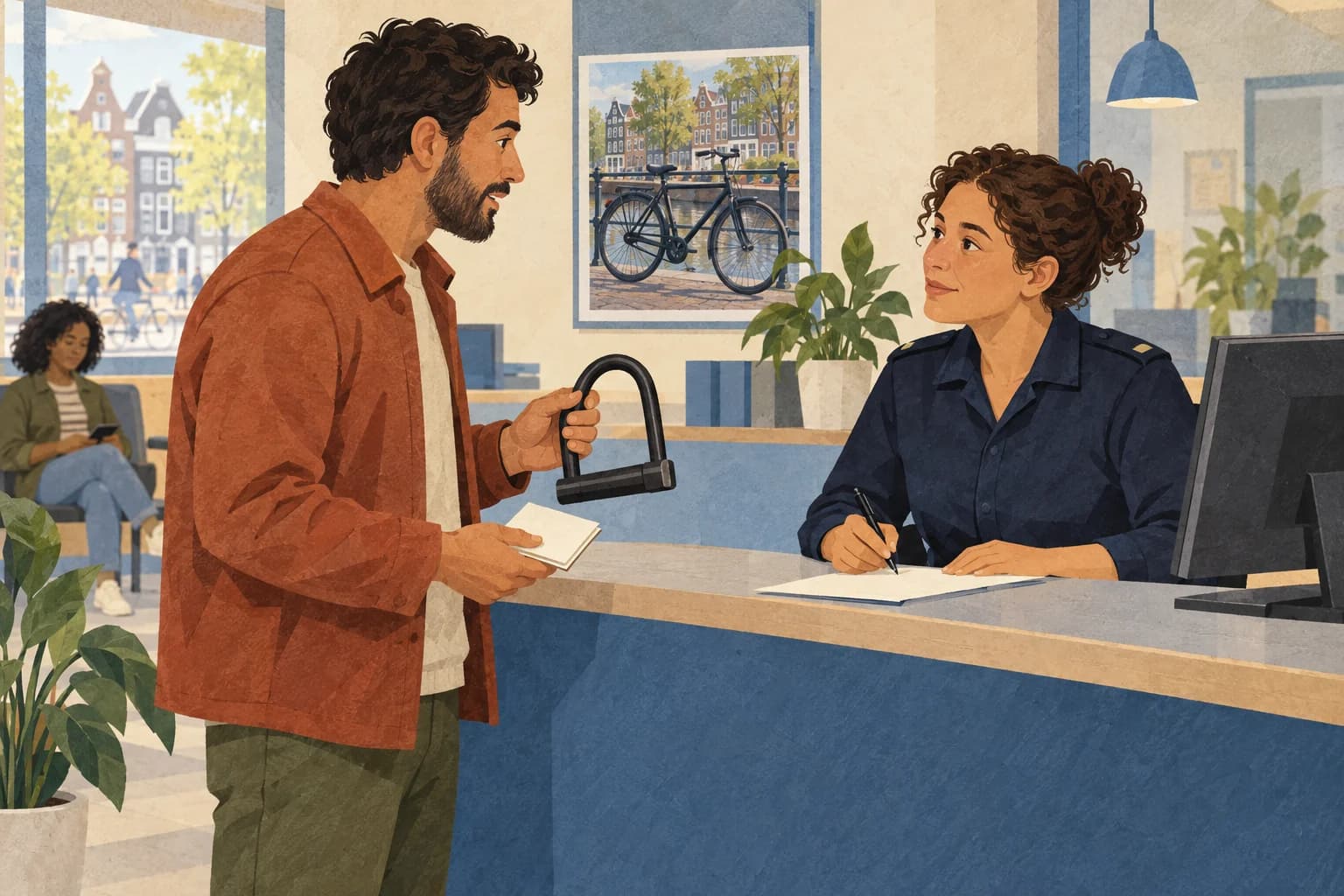
The police help maintain safety, investigate criminal offences, ensure supervision, and enforce rules. In case of immediate danger or an acute emergency, call 112. For instance, this applies to serious violence or an accident requiring help straight away. For a stolen bicycle without urgency, or a question about nuisance, you use the regular police contact route. This makes sure the emergency number stays available for situations where every minute counts.
A report and a formal complaint ('aangifte') are not the same. By reporting something, you inform the police about what is happening; with an aangifte, you ask the police to formally record a criminal offence for investigation. The police will explain which procedure is appropriate. Say what you know: the place, time, people involved, and what you saw. Keep a record number or confirmation. For certain very serious crimes, such as murder, manslaughter or kidnapping, there is a legal duty to make a formal complaint (aangifte). Ask the police how to do this; if there is danger, call 112 first.
While performing their duties, a police officer may give instructions. Follow these instructions and calmly ask for an explanation if you do not understand something. From the age of 14, you must be able to show a valid proof of identity to an authorised person if requested. In public transport, this obligation can in some situations begin from the age of 12, for example during checks when travelling without a valid ticket. You are not required to hand over your proof of identity to a stranger in ordinary situations.
You can also go to the police for fraud, discrimination, threats, or sexual violence. Take messages, photos or other relevant information with you if it is safe to do so. If you are not sure whether something is an offence, you are allowed to ask the police for advice. They can explain whether reporting, making a formal complaint, or other help is the appropriate next step.
Check your understanding
When do you use 112 instead of the regular police route? Show answer
In case of immediate danger or another acute emergency.
Non-urgent reports go through ordinary channels.
From what age does the general obligation to show proof of identity apply, when requested by an authorised person? Show answer
From the age of 14.
In public transport, the identification obligation can apply from the age of 12 in some situations, for instance when travelling without a valid ticket.
You know about a kidnapping and there may be immediate danger. What do you do? Show answer
Call 112 if there is immediate danger and report the serious crime to the police; ask how to make a formal complaint ('aangifte').
Emergency help and a formal complaint serve different purposes.
Your bicycle was stolen yesterday. Is 112 the usual route? Show answer
No. Use the police’s non-urgent reporting procedure (the ordinary aangifte/reporting route).
112 is for immediate danger or acute emergencies.
An officer asks you to leave a cordoned area. What do you do? Show answer
Follow the instruction and calmly ask for an explanation if you do not understand.
The police have supervisory and enforcement duties.
Sources: zoek.officielebekendmakingen.nl · stcrt 2024 15802.html · rijksoverheid.nl · geldt de identificatieplicht ook voor minderjarigen · politie.nl · ik ben slachtoffer moet ik aangifte doen.html
Original Dutch text
Wanneer je de politie nodig hebt
De politie helpt bij veiligheid, onderzoekt strafbare feiten, houdt toezicht en handhaaft regels. Bij direct gevaar of een acute noodsituatie bel je 112. Denk aan ernstig geweld of een ongeluk waarbij onmiddellijk hulp nodig is. Voor een fietsdiefstal zonder spoed of een vraag over overlast gebruik je de gewone contactroute van de politie. Zo blijft het noodnummer beschikbaar voor situaties waarin iedere minuut telt.
Een melding en een aangifte zijn niet hetzelfde. Met een melding laat je weten wat er speelt; bij een aangifte vraag je de politie een strafbaar feit vast te leggen voor onderzoek. De politie legt uit welke route past. Vertel wat je zelf weet: plaats, tijd, personen en wat je hebt gezien. Bewaar een nummer of bevestiging. Bij bepaalde zeer ernstige misdrijven, zoals moord, doodslag en ontvoering, bestaat een wettelijke plicht om aangifte te doen. Vraag de politie hoe dit moet; bij gevaar bel je eerst 112.
Een politieagent kan bij het uitvoeren van zijn taak aanwijzingen geven. Volg die op en vraag rustig om uitleg als je iets niet begrijpt. Vanaf 14 jaar moet je op verzoek van een bevoegde persoon een geldig identiteitsbewijs kunnen tonen. In het openbaar vervoer kan deze plicht in bepaalde situaties al vanaf 12 jaar gelden, bijvoorbeeld bij controle zonder geldig vervoersbewijs. Je hoeft je identiteitsbewijs niet zomaar aan een onbekende te geven.
Je kunt ook naar de politie gaan bij oplichting, discriminatie, bedreiging of seksueel geweld. Neem berichten, foto’s of andere relevante informatie mee als dat veilig kan. Weet je niet of iets strafbaar is, dan mag je de politie om advies vragen. Zij kan uitleggen of een melding, aangifte of andere hulp de juiste volgende stap is.
Controleer wat je weet
Wanneer gebruik je 112 in plaats van de gewone politieroute? Toon antwoord
Bij direct gevaar of een andere acute noodsituatie.
Niet-dringende meldingen gaan via gewone kanalen.
Vanaf welke leeftijd geldt de algemene identificatieplicht op verzoek van een bevoegd persoon? Toon antwoord
Vanaf 14 jaar.
In het openbaar vervoer kan vanaf 12 jaar in bepaalde situaties een identificatieplicht gelden, bijvoorbeeld bij reizen zonder geldig vervoerbewijs.
Je weet van een ontvoering en er is mogelijk direct gevaar. Wat doe je? Toon antwoord
Bel 112 bij direct gevaar en geef het ernstige misdrijf door aan de politie; vraag hoe je aangifte doet.
Noodhulp en de formele aangifte hebben verschillende functies.
Je fiets is gisteren gestolen. Is 112 de gewone route? Toon antwoord
Nee. Gebruik de niet-dringende aangifteroute van de politie.
112 is voor direct gevaar of acute nood.
Een agent vraagt je een afzetting te verlaten. Wat doe je? Toon antwoord
Volg de aanwijzing op en vraag rustig om uitleg als je iets niet begrijpt.
De politie heeft een toezichthoudende en handhavende taak.