History and geography
Use knowledge of Dutch places and public transport.
All knowledge points: Getting to know the Netherlands and your region · Travelling by public transport
Sources checked on
Beta version: the content and translations are still being reviewed. Check official sources before making decisions about your exam.
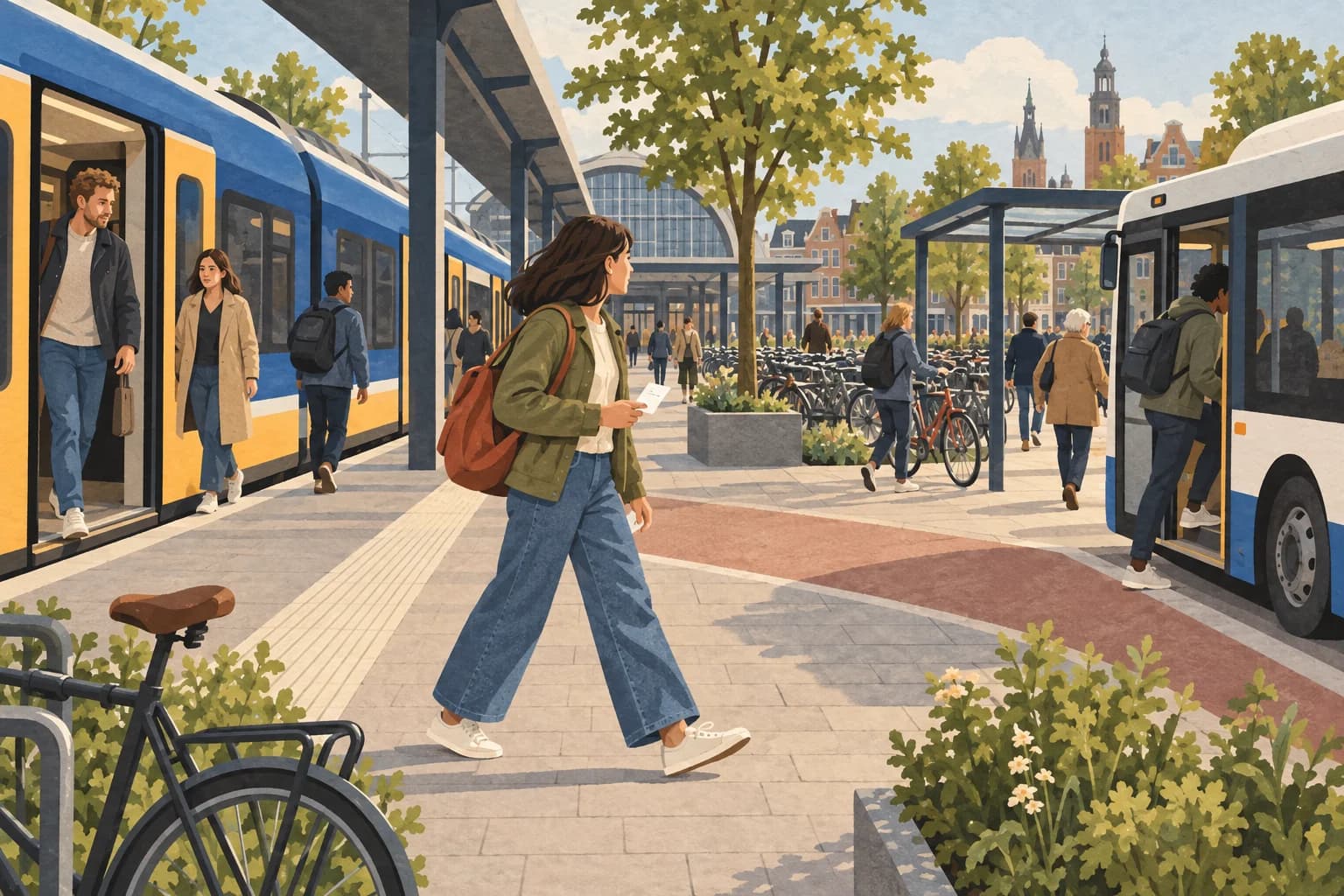
Getting to know the Netherlands and your region

Amsterdam is the capital city of the Netherlands. The government and parliament mainly work in The Hague. The Netherlands has twelve provinces. Use the provincial map in this chapter to practise the names and locations; the boundaries and Dutch-language labels come from Kadaster/PDOK data from 2026.
The provinces are Groningen, Fryslân (Friesland), Drenthe, Overijssel, Gelderland, Flevoland, Utrecht, Noord-Holland, Zuid-Holland, Zeeland, Noord-Brabant and Limburg. Look them up one by one on the map. Groningen, Fryslân and Drenthe are in the north; Zeeland in the southwest; Limburg in the southeast. Use the map for the exact borders.
Next, look up your own province. Write down its name and point out your place of residence and two nearby towns or villages. Use a current map of your municipality or region to check where a school, hospital and station are located. Find a travel route to one of them.
Research the options in your region: look for a home via the local housing seekers' organisation, a vacancy via a job site, and training via a school or education website. Write down the location and travel time for each result. Also compare one neighbouring region: the supply and costs can be different there.
A map helps you to orient yourself, but current addresses, available housing and departure times must be checked separately. Map source: Kadaster/PDOK, provinces 2026; modified with attribution under CC BY 4.0.
Try this
- Find all twelve provinces on the map and practise their locations.
- Mark your province, your place of residence and two nearby places.
- Find one home, job and training in your region and check the travel time.
Check your understanding
Which city is the capital and where does the government mainly work? Show answer
Amsterdam is the capital; the government mainly works in The Hague.
The capital city and the seat of government are not the same place.
Find Groningen, Zeeland and Limburg on the map. Where are they situated? Show answer
Groningen in the northeast, Zeeland in the southwest and Limburg in the southeast.
Check the provincial boundaries on the accurate map in this chapter.
Use the map and a current regional source. What is your province, which two places are nearby, and where can you find a training or job opportunity? Show answer
The answer depends on your place of residence; give the correct province, two real nearby places and an up-to-date source with location and travel time.
This exercise lets you apply map knowledge to your own opportunities.
Sources: zoek.officielebekendmakingen.nl · stcrt 2024 15802.html · cbs.nl · kaarten regionale indelingen · api.pdok.nl · items · creativecommons.org · 4.0
Original Dutch text
Nederland en jouw regio leren kennen
Amsterdam is de hoofdstad van Nederland. De regering en het parlement werken vooral in Den Haag. Nederland heeft twaalf provincies. Gebruik de provinciekaart bij dit hoofdstuk om de namen én ligging te oefenen; de grenzen en Nederlandstalige labels komen uit Kadaster/PDOK-gegevens van 2026.
De provincies zijn Groningen, Fryslân (Friesland), Drenthe, Overijssel, Gelderland, Flevoland, Utrecht, Noord-Holland, Zuid-Holland, Zeeland, Noord-Brabant en Limburg. Zoek ze één voor één op de kaart. Groningen, Fryslân en Drenthe liggen in het noorden; Zeeland in het zuidwesten; Limburg in het zuidoosten. Kijk naar de kaart voor de precieze grenzen.
Zoek daarna jouw eigen provincie op. Schrijf de naam op en wijs je woonplaats en twee steden of dorpen in de buurt aan. Gebruik een actuele kaart van je gemeente of regio om te controleren waar een school, ziekenhuis en station liggen. Zoek een reisroute naar één daarvan.
Onderzoek de mogelijkheden in je regio: zoek een woning via de lokale woningzoekendenorganisatie, een vacature via een vacaturebank en een opleiding via een school of opleidingswebsite. Noteer bij elk resultaat de plaats en reistijd. Vergelijk ook één naburige regio: daar kunnen aanbod en kosten anders zijn.
Een kaart helpt je oriënteren, maar actuele adressen, woonaanbod en vertrektijden moet je apart controleren. Kaartbron: Kadaster/PDOK, provinciegebieden 2026; bewerking met naamsvermelding volgens CC BY 4.0.
Probeer dit
- Zoek alle twaalf provincies op de kaart en oefen hun ligging.
- Markeer jouw provincie, woonplaats en twee plaatsen in de buurt.
- Zoek één woning, vacature en opleiding in je regio en controleer de reistijd.
Controleer wat je weet
Welke stad is de hoofdstad en waar werkt de regering vooral? Toon antwoord
Amsterdam is de hoofdstad; de regering werkt vooral in Den Haag.
De hoofdstad en regeringsstad zijn niet dezelfde plaats.
Zoek op de kaart Groningen, Zeeland en Limburg. Waar liggen zij? Toon antwoord
Groningen in het noordoosten, Zeeland in het zuidwesten en Limburg in het zuidoosten.
Controleer de provinciegrenzen op de nauwkeurige kaart bij dit hoofdstuk.
Gebruik de kaart en een actuele regionale bron. Welke provincie is jouw woonplaats, welke twee plaatsen liggen in de buurt en waar vind je een opleiding of vacature? Toon antwoord
Het antwoord hangt af van je woonplaats; noem de juiste provincie, twee echte nabije plaatsen en een actuele bron met plaats en reistijd.
Met deze oefening pas je kaartkennis toe op je eigen mogelijkheden.
Travelling by public transport
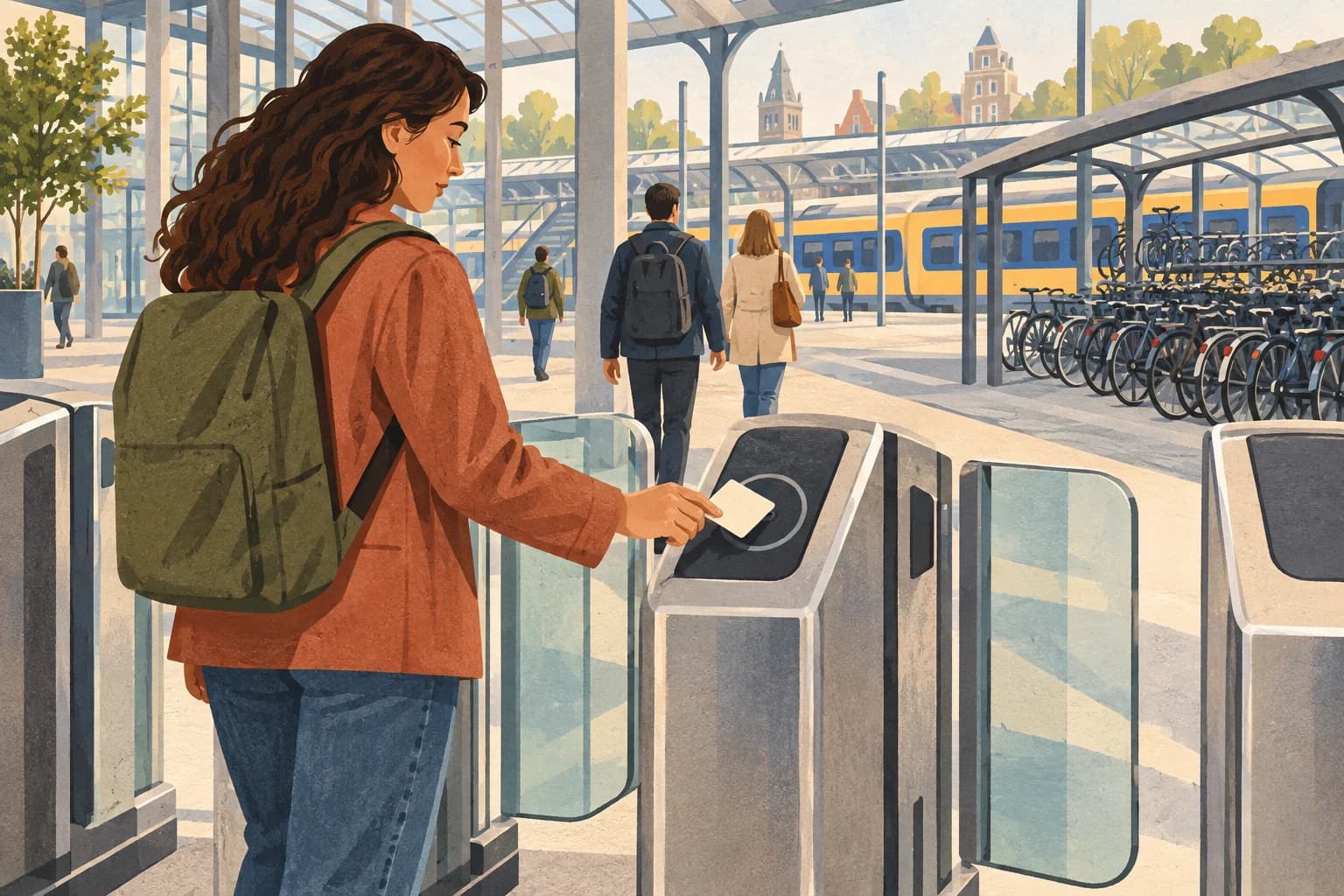
In the Netherlands, you can travel by train, bus, tram and metro. Depending on your journey, you may pay with an OV-chipkaart, payment card, phone, or a separate ticket. Check the website of the transport company to see which payment method is accepted and whether you are entitled to a discount.
Plan a journey independently in steps. Enter your departure point, destination, and desired arrival time in a journey planner. Look at the departure time, stop or platform, transfers and journey time. Then check how to check in and out with each operator. For one journey, use the same card or device for both check-in and check-out, according to the instructions of the operator.
Suppose you first take the bus to the station, then the train. Check the bus stop and the train on the signs. Check in and out where the transport companies indicate; with a transfer between operators, checking in again may be required. Check shortly before departure whether the bus or train is still running.
If the train is cancelled, use the journey planner or operator’s website to find a new connection. See if you can start your appointment later and notify them in time. Ask staff for help if you do not understand the transfer or payment method. Keep your ticket if needed.
Try this
- Plan the journey based on arrival time and note every transfer.
- Check per operator the ticket and the place to check in and out.
- Check for disruptions shortly before departure and plan an alternative if needed.
Check your understanding
What do you check before you travel by train and bus? Show answer
Route, departure time, transfer and method of payment or check-in.
Also check for changes just before you leave.
You travel first by bus and then by train. What four things do you check before you leave? Show answer
Departure and arrival time, transfer, payment method and where to check in and out with both operators.
A transfer between companies may require separate actions.
Your train is cancelled and you have an appointment. What do you do? Show answer
Find an up-to-date alternative route, ask staff for help if needed, and notify your contact in time that you will be late.
Being able to travel independently also means responding to changes.
Sources: zoek.officielebekendmakingen.nl · stcrt 2024 15802.html · ovpay.nl
Original Dutch text
Met het openbaar vervoer reizen
In Nederland kun je reizen met trein, bus, tram en metro. Je kunt afhankelijk van de reis betalen met een OV-chipkaart, betaalpas, telefoon of een apart vervoersbewijs. Kijk op de website van de vervoerder welke betaalwijze geldt en of je recht hebt op korting.
Plan een reis zelfstandig in stappen. Vul vertrekpunt, bestemming en gewenste aankomsttijd in een reisplanner in. Bekijk vertrektijd, halte of spoor, overstap en reistijd. Controleer daarna hoe je bij elke vervoerder in- en uitcheckt. Gebruik bij één reis dezelfde kaart of hetzelfde apparaat voor in- en uitchecken volgens de instructies van de vervoerder.
Stel: je gaat eerst met de bus naar het station en daarna met de trein. Controleer de bushalte en de trein op de borden. Check in en uit waar de vervoerders dat aangeven; bij een overstap tussen vervoerders kan opnieuw inchecken nodig zijn. Controleer kort voor vertrek of de bus of trein nog rijdt.
Valt de trein uit? Zoek in de reisplanner of op de vervoerdersite een nieuwe verbinding. Kijk of je afspraak later kan beginnen en laat dat op tijd weten. Vraag personeel om hulp als je de overstap of betaalwijze niet begrijpt. Bewaar je vervoersbewijs als dat nodig is.
Probeer dit
- Plan de route op aankomsttijd en noteer elke overstap.
- Controleer per vervoerder het bewijs en de plaats van in- en uitchecken.
- Bekijk kort voor vertrek storingen en plan zo nodig een alternatief.
Controleer wat je weet
Wat controleer je voordat je met trein en bus reist? Toon antwoord
Route, vertrektijd, overstap en manier van betalen of inchecken.
Controleer kort voor vertrek ook wijzigingen.
Je reist eerst met bus en daarna met trein. Welke vier dingen controleer je voor vertrek? Toon antwoord
Vertrek- en aankomsttijd, overstap, betaalwijze en waar je bij beide vervoerders in- en uitcheckt.
Bij een overstap tussen vervoerders kunnen aparte handelingen nodig zijn.
Je trein valt uit en je hebt een afspraak. Wat doe je? Toon antwoord
Zoek een actuele alternatieve route, vraag zo nodig personeel om hulp en meld op tijd dat je later komt.
Zelfstandig reizen betekent ook op een wijziging kunnen reageren.